feature
What Makes a Leica Noctilux Distinctive?
Sixty years, four optical formulas, one idea: a 50mm lens that sees in the dark. The history and character of Leica's fastest nameplate.
Kamera Express
The name is a small mission statement: Nocti, from nocturnal, and lux, Latin for light. Since 1966, Leica's Noctilux lenses have pursued a single extreme, gathering more light through a 50mm M-mount lens than anyone thought practical, and in doing so they acquired something rarer than speed: a recognizable visual character that photographers discuss the way wine drinkers discuss vintages.
The original Noctilux 50mm f/1.2, released at Photokina in 1966, was the first serially produced lens in the world to employ aspherical elements. Its two aspherical surfaces were ground by hand on a specially built machine operated by a single skilled craftsman, which kept production to a trickle: approximately 1,757 examples were made before production ended in 1975. Surviving copies are now among the most sought-after M lenses at auction.
The f/1 era
In 1975, Dr. Walter Mandler, working at Leica's Midland, Ontario plant, designed the replacement: a 50mm f/1 lens of seven elements in six groups that deliberately avoided aspherical surfaces in favor of consistent, manufacturable quality. Launched in 1976, it remained in production for over thirty years without significant alteration to its optical formula, becoming for a generation the definitive expression of what admirers call the Leica look: sharp where it matters, with a gentle, glowing rendering wide open that flatters skin and dissolves backgrounds.
The f/0.95 and the reissue
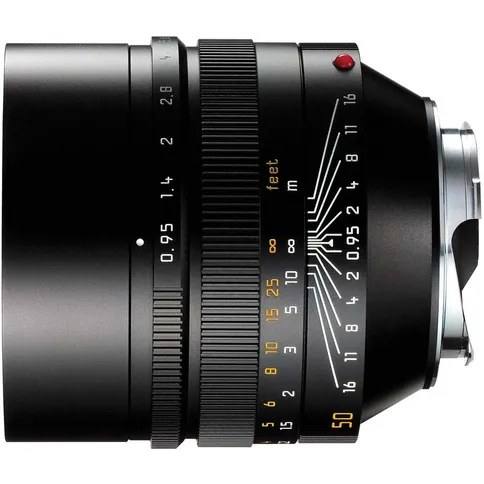
The current flagship, the Noctilux-M 50mm f/0.95 ASPH, arrived in 2008. Eight elements in five groups, two aspherical surfaces, five anomalous partial dispersion elements and three high-refractive-index elements, a floating element holding quality from one meter to infinity, 700 grams of brass and glass focusing to f/16. Leica's own product description makes the characteristic explicit: the extremely shallow depth of field at full aperture produces portraits of striking aesthetic effect, and even slightly stopped down the lens delivers outstanding image quality comparable to the Summilux-M 50mm f/1.4 ASPH. In available light, the company notes, even a single candle can suffice for handheld photography.
Then, in January 2021, Leica did something unusual: it brought back the 1966 original. The reissued Noctilux-M 50mm f/1.2 ASPH joined the Leica Classics range with its calculation kept so close to the original that Leica described the imaging results as nearly identical, offered in black anodized finish at $7,695 alongside a silver chrome edition limited to 100 units at $16,395.
What makes the Noctilux distinctive, in the end, is that its flaws are deliberate. Wide open it is not the sharpest 50mm Leica makes; stopped down, it nearly is. The character lives in between, in the particular way it renders the out-of-focus world, and sixty years of photographers have decided that character is worth more than perfection.
Spotted an error? We correct openly: see our corrections policy.