explainer
Understanding the Leica M System
Seventy years after the M3, the rangefinder remains Leica's defining idea. How one mount, one viewfinder, and a stubborn philosophy survived the digital age.
Leica Camera AG
In 1954, at Photokina, Ernst Leitz GmbH introduced the Leica M3, and with it a system that has now outlasted nearly every other camera platform ever made. The M3 combined the viewfinder and the rangefinder into a single bright window, added a bayonet lens mount in place of the old screw thread, and displayed framelines for 50, 90 and 135mm lenses directly in the finder. Its 0.92x magnification viewfinder remains the highest ever fitted to an M camera. By the time production ended in the late 1960s, more than 220,000 M3 bodies had been built, making it the most successful M model of its era.
The letter M comes from Messsucher, the German word for rangefinder, and the mount introduced on the M3 is the mount Leica still uses today. Lenses change faster on a bayonet than on a screw thread, and the framelines set themselves automatically to the attached lens. That mechanical contract between body and lens, fixed in 1954, is the foundation everything since has been built on.
The rangefinder idea
A rangefinder camera asks the photographer to do the focusing. Two images of the subject are superimposed in the viewfinder, and the photographer turns the focus ring until they coincide. There is no mirror blackout, no autofocus hunting, and the framelines show slightly more than the lens will capture, so the photographer sees action entering the frame before it is recorded. It is a slower, more deliberate way of working, and for seventy years a loyal constituency has considered that a feature rather than a limitation.
The film decades refined the formula without breaking it. The M2 of 1958 was a scaled-down, lower-cost M3 whose 0.72x finder made 35mm lenses easier to use, and that magnification became the standard for most M cameras that followed.
The digital M
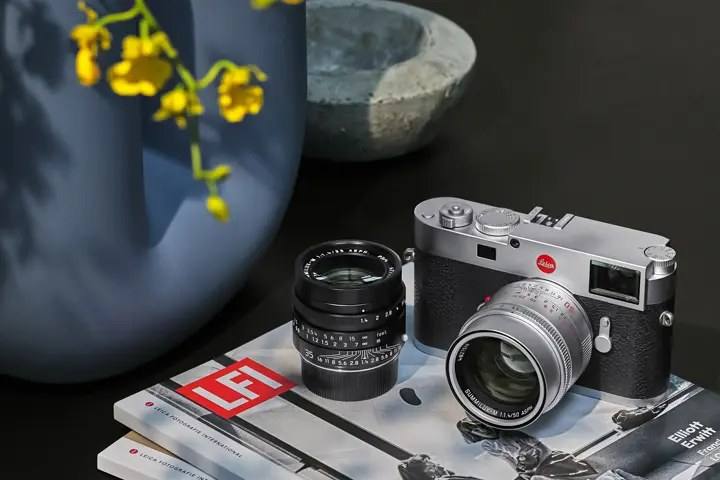
The current reference point is the Leica M11, launched in January 2022. It is built around an exclusively designed full-frame BSI CMOS sensor with Triple Resolution Technology, offering a choice of 60, 36 or 18 megapixels while always using the full sensor area. Sensitivity runs from ISO 64 to 50,000 at 14-bit color depth, with dynamic range stated at up to 15 stops, and the body carries 64 gigabytes of internal memory alongside its SD slot. The black version uses an aluminum top cover and weighs about 530 grams; the silver chrome version keeps the classic brass top plate.
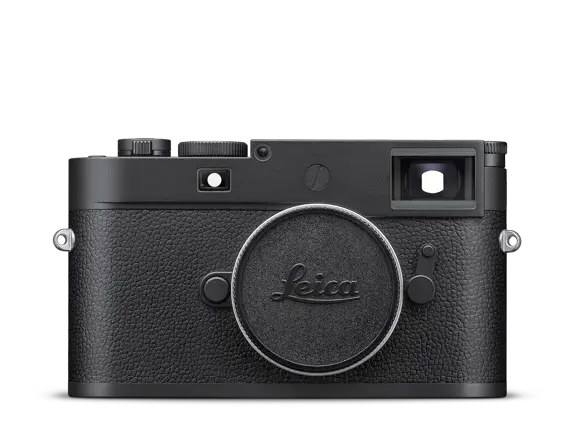
The platform has since branched in two telling directions. The Leica M11 Monochrom, announced in April 2023, is the fourth monochrome-only M body, with a dedicated black-and-white BSI sensor, an ISO range of 125 to 200,000 and 256 gigabytes of internal memory. The Leica M11-P, launched on 26 October 2023 at $9,195, became the world's first camera to attach Content Credentials to images at the point of capture, embedding a CAI-compliant digital signature under the C2PA open standard so an image's provenance can be verified from capture to publication. In keeping with P-series tradition, it omits the red dot in favor of engraved top-plate lettering.
What is remarkable is not any single specification but the continuity. The M mount of 2026 is the M mount of 1954. Lenses designed for film bodies meter and focus on digital ones, and the viewfinder still shows the world the way the M3 did: directly, with framelines, and with the photographer responsible for the decisive moment.
Leica Camera AG
Spotted an error? We correct openly: see our corrections policy.